Showing posts with label type Ia. Show all posts

Wednesday, May 17, 2023

A radio-detected Type Ia supernova with helium-rich circumstellar material

arXiv:

However, despite extensive efforts, no SN Ia has ever been detected at radio wavelengths, which suggests a clean environment and a companion star that is itself a degenerate WD star. Here we report on the study of SN 2020eyj, a SN Ia showing helium-rich CSM, as revealed by its spectral features, infrared emission and, for the first time in a SN Ia, a radio counterpart. Based on our modeling, we conclude the CSM likely originates from a single-degenerate (SD) binary system where a WD accretes material from a helium donor star, an often hypothesized formation channel for SNe Ia. 

nature

The CSM interaction in SN 2020eyj is also confirmed, for the first time in a SN Ia, through the detection of a radio counterpart, at a frequency of 5.1 GHz at 605 and 741 days after the first detection. Follow-up in the X-rays did not yield a detection. We model the radio synchrotron emission, which results from the shock interaction between the ejecta and the CSM.

For the SD shell model, the radio detections are best explained with a CSM mass of M_csm = 0.36 M⊙ (see ‘CSM shells’ section in Methods), with the expectation that the radio light curve will start to drop off rapidly at around 900 days. 


 Previously on this blog:
Sunday, May 7, 2023

Constraining Type Ia Supernova Progenitors the Apian Way

arXiv:

We present very early photometric and spectroscopic observations of the Type Ia supernova (SN) 2023bee, starting about 8 hours after the explosion, which reveal a strong excess in the optical and nearest UV (U and UVW1) bands during the first several days of explosion.

We find a good match to the Kasen model in which a main-sequence companion star stings the ejecta with a shock as they buzz past. Models of double detonations, shells of radioactive nickel near the surface, interaction with circumstellar material, and pulsational-delayed detonations do not provide good matches to our light curves. We also observe signatures of unburned material, in the form of carbon absorption, in our earliest spectra.

This is an exciting result out of my research group at Las Cumbres Observatory!

Taken together, our observations above suggest that the emission from SN 2023bee during the first few days after explosion consists of typical Type Ia SN spectral features plus an additional hot continuum component. 

This Letter demonstrates the power of using very high-cadence, multiband photometry of young, nearby Type Ia SNe to constrain their progenitor systems, which is only possible with specially designed robotic facilities like the DLT40 Survey, Las Cumbres Observatory, and Swift.  


Previously on this blog:

Tuesday, March 14, 2023

The core degenerate scenario for the type Ia supernova SN 2020eyj

arXiv:

We argue that the core degenerate (CD) scenario of type Ia supernovae (SNe Ia) can explain the compact helium-rich circumstellar material (CSM) of SN 2020eyj...We follow the evolution of two stellar models with initial masses of 5Mo and 7Mo to their asymptotic giant branch phase when they are supposed to engulf the WD companion. We find that there is a sufficiently massive CO core to merge with the WD in the frame of the CD scenario as well as a massive helium-rich layer, ~0.3-1Mo, to account for the helium-rich CSM of SN 2020eyj.

The motivation of our study is the new observations of SN 2020eyj, a SN Ia-CSM with a helium-rich CSM (Kool et al. 2022) and the need to consider all SN Ia scenarios when analysing observations, as the long list of recent papers that study different scenarios suggests.

Building on earlier papers that argue for the CD scenario for SNe Ia-CSM (section 2) we propose the CD scenario also for SN 2020eyj, but we consider a new channel that accounts for the helium-rich CSM (section 3).


Wednesday, March 1, 2023

Initial Flash and Spectral Formation of Type Ia Supernovae with An Envelope: Applications to Over-luminous SNe Ia

arXiv:

Over-luminous type Ia supernovae (SNe Ia) show peculiar observational features, for which an explosion of a super-massive white dwarf (WD) beyond the classical Chandrasekhar-limiting mass has been suggested, largely based on their high luminosities and slow light-curve evolution.

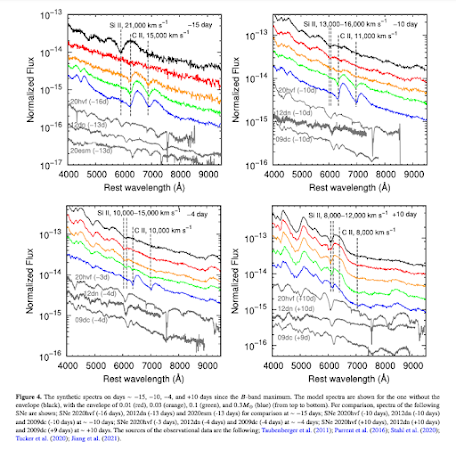
In the present work, we suggest a scenario that provides a unified solution to these peculiarities, through hydrodynamic and radiation transfer simulations together with analytical considerations; a C+O-rich envelope (~0.01 - 0.1 Msun) attached to an exploding WD. Strong C II lines are created within the shocked envelope.

The scenario thus can explain some of the key diverse observational properties by a different amount of the envelope, but additional factors are also required; we argue that the envelope is distributed in a disc-like structure, and also the ejecta properties, e.g., the mass of the WD, plays a key role.

Interestingly, the proposed scenario can also be tested for normal (non overluminous) SNe Ia:

Indeed, by combining the expected properties as summarized above, we can comprehensively test this scenario for SNe Ia with intensive observational coverage from the infant to late phases; the present work thus provides one strong motivation for the high-cadence survey and prompt follow-up observation for SNe Ia of various subclasses, especially nearby events that allow longterm monitoring toward the late phase.  

The predicted spectra are shown in Figure 4:


The sleep mask that solved my sleep problems

As previously reported on this blog, I've been actively seeking ways to unwind and, in particular, improve my quality of sleep. I've...