Showing posts with label radio. Show all posts

Monday, November 20, 2023

Detection of long-lasting aurora-like radio emission above a sunspot

nature astronomy:

Here we report observations of long-lasting solar radio bursts with high brightness temperature, wide bandwidth and high circular polarization fraction akin to these auroral and exo-auroral radio emissions, albeit two to three orders of magnitude weaker than those on certain low-mass stars. Spatially, spectrally and temporally resolved analysis suggests that the source is located above a sunspot where a strong, converging magnetic field is present. 

Our findings offer new insights into the origin of such intense solar radio bursts and may provide an alternative explanation for aurora-like radio emissions on other flare stars with large starspots.
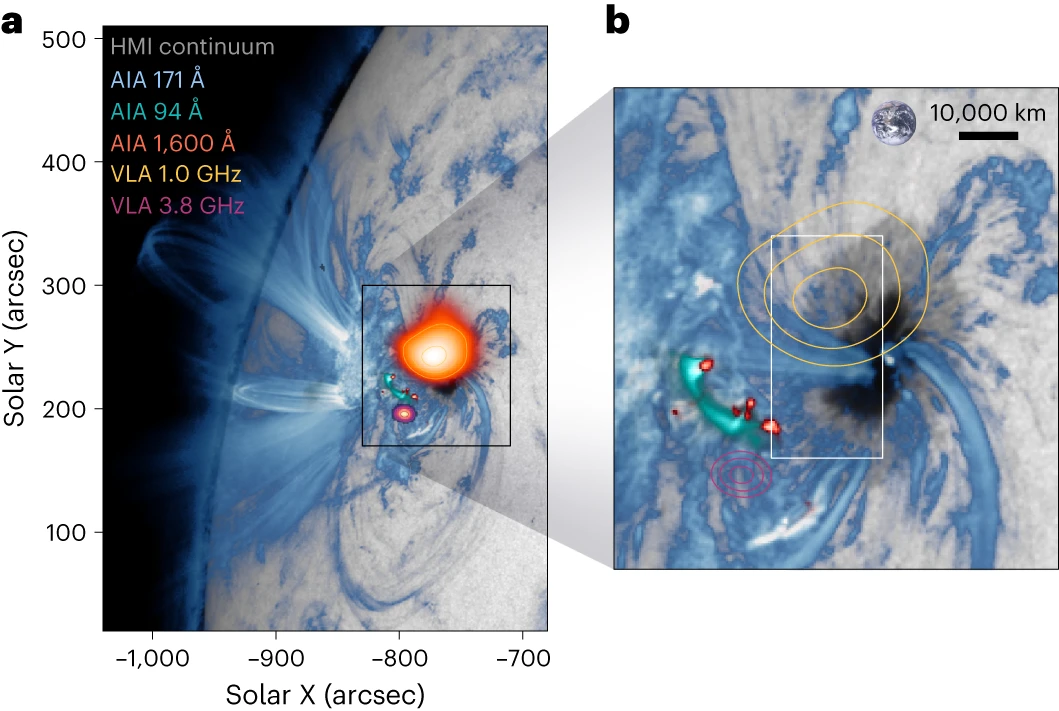

(Figure 1 caption) a, Example of a VLA snapshot image at 1.0 GHz (orange) of the radio emission from the sunspot with the image of the radio-hosting NOAA 12529 AR observed in EUV wavelengths by the AIA, 171 Å (blue), 94 Å (cyan) and 1,600 Å (red) overlaid on the photospheric image observed by the HMI aboard the SDO. Also shown is a VLA 3.8 GHz image (magenta) of the radio emission from the flare site. b, Closer view of the sunspot region (box in a). The 1.0 GHz and 3.8 GHz are shown as yellow and magenta contours, respectively, at 50%, 70% and 90% of the maximum. The white box in b is discussed further at Fig. 4.

LiveScience:

Scientists have spotted a stunning "aurora-like" display of crackling radio waves over the surface of the sun that is strikingly similar to the Northern Lights on Earth. 

"This is quite unlike the typical, transient solar radio bursts typically lasting minutes or hours," lead author Sijie Yu, an astronomer at New Jersey Institute of Technology's Center for Solar-Terrestrial Research (NJIT-CSTR), said in a statement. "It's an exciting discovery that has the potential to alter our comprehension of stellar magnetic processes."

The researchers say their discovery has opened up new ways to study the sun's activity, and they have begun poring through archival data to find hidden evidence of past solar auroras. "We're beginning to piece together the puzzle of how energetic particles and magnetic fields interact in a system with the presence of long-lasting starspots," study co-author Surajit Mondal, a solar physicist at NJIT, said in the statement. "Not just on our own Sun but also on stars far beyond our solar system."

This is a really exciting discovery! The resolution required to do this kind of work is fairly low so it seems completely plausible that past observations of the Sun in radio may have captured these sorts of effects. The duration is also interesting--a week is a long time for solar processes. Something I'm particularly curious about is whether we expect to see more of these now that a long and early solar maximum is just around the corner.

NOAA:

NOAA’s Space Weather Prediction Center (SWPC) issued a revised prediction for solar activity during Solar Cycle 25 that concludes solar activity will increase more quickly and peak at a higher level than that predicted by an expert panel in December 2019. The updated prediction now calls for Solar Cycle 25 to peak between January and October of 2024, with a maximum sunspot number between 137 and 173.

The solar maximum is a period in the solar cycle when the Sun's activity, particularly in terms of sunspots and solar flares, is at its highest. The solar cycle is an approximately 11-year cycle during which the Sun undergoes a regular pattern of changes in solar activity. This cycle is characterized by the waxing and waning of the number of sunspots on the Sun's surface.

During solar maximum, the number of sunspots is at its peak, and solar activity is generally more intense. Sunspots are temporary phenomena on the Sun's photosphere that appear as spots darker than the surrounding areas. They are associated with strong magnetic activity and are often the source of solar flares and coronal mass ejections (CMEs). It therefore seems pretty reasonable to me that we might expect more of these aurora-like transients, which seemed to form above a large sunspot.


Previously on this blog:

ALMA Achieve Unprecedented Resolution to Observe the Universe

ALMA Observatory:

An international team of astronomers and engineers has successfully conducted an observation that achieved an extraordinary resolution of 5 milliarcseconds, using ALMA's highest frequency Band 10 receiver and an array configuration that spans 16 kilometers. 

This groundbreaking observation allowed the team to capture unprecedented details of a maser around an evolved star within the Milky Way. 

Yoshiharu Asaki, the ALMA Astronomer who led this project, highlighted the collaborative effort: "This remarkable achievement in high-resolution imaging through ALMA's advanced capabilities marks a significant milestone in our quest to understand the Universe. The success of the Band 10 high-resolution observation showcases our commitment to innovation and reinforces ALMA's position as a leader in astronomical discovery. We are excited about the new possibilities for the scientific community."

5 milliarcseconds is certainly an impressive resolution. For comparison, the VLBI array that examined SN 1993J at 8 GHz achieved a resolution of ~1 milliarcsecond. For a single station to achieve this is incredible.

ApJ:

The Atacama Large Millimeter/submillimeter Array (ALMA) was used in 2021 to image the carbon-rich evolved star R Lep in Bands 8–10 (397–908 GHz) with baselines up to 16 km. The goal was to validate the calibration...and the imaging procedures required to obtain the maximum angular resolution achievable with ALMA.

It's quite interesting seeing that the paper is very focused on what amounts to a test and validation of the capabilities of ALMA, but still got good coverage in the media. This isn't a bad thing at all--usually buzzwordy science results grab all the attention--and it's nice to see a shift towards interest in some of the technical aspects of the field.


Wednesday, May 17, 2023

A radio-detected Type Ia supernova with helium-rich circumstellar material

arXiv:

However, despite extensive efforts, no SN Ia has ever been detected at radio wavelengths, which suggests a clean environment and a companion star that is itself a degenerate WD star. Here we report on the study of SN 2020eyj, a SN Ia showing helium-rich CSM, as revealed by its spectral features, infrared emission and, for the first time in a SN Ia, a radio counterpart. Based on our modeling, we conclude the CSM likely originates from a single-degenerate (SD) binary system where a WD accretes material from a helium donor star, an often hypothesized formation channel for SNe Ia. 

nature

The CSM interaction in SN 2020eyj is also confirmed, for the first time in a SN Ia, through the detection of a radio counterpart, at a frequency of 5.1 GHz at 605 and 741 days after the first detection. Follow-up in the X-rays did not yield a detection. We model the radio synchrotron emission, which results from the shock interaction between the ejecta and the CSM.

For the SD shell model, the radio detections are best explained with a CSM mass of M_csm = 0.36 M⊙ (see ‘CSM shells’ section in Methods), with the expectation that the radio light curve will start to drop off rapidly at around 900 days. 


 Previously on this blog:

Sunday, February 12, 2023

Discovery of an isolated dark dwarf galaxy in the nearby universe

arXiv (accepted for publication in ApJ):  

Based on a new H I survey using the Five-hundred-meter Aperture Spherical radio Telescope (FAST), combined with the Pan-STARRS1 images, we identified an isolated H I cloud without any optical counterpart, named FAST J0139+4328...These findings provide observational evidence that FAST J0139+4328 is an isolated dark dwarf galaxy with a redshift of z = 0.0083.
Moreover, this disk galaxy has an extremely low absolute magnitude (M_B >-10.0 mag).

This is an insanely low absolute magnitude. For reference, a normal absolute magnitude for a galaxy like this might be around 10.

Furthermore, we obtained that the H I mass of this galaxy is (8.3±1.7)e7 SM, and the dynamical mass to total baryonic mass ratio is 47±27, implying that dark matter dominates over baryons in FAST J0139+4328. 

That's a substantial error bar--I wonder if future observations can constrain that much better.

ScienceAlert:

And they got a hit: the radio waves emitted by a cloud of HI 94 million light-years away were consistent with a rotating disk galaxy, without the optical light expected of one. Follow-up observations in infrared and ultraviolet revealed a faint smattering of stars.

 "This is the first time that a gas-rich isolated dark galaxy has been detected in the nearby Universe," the researchers write.

There are a few other dark galaxy candidates, namely HI 1225+01 (ADS) and HI1232+20 (arXiv). 

The sleep mask that solved my sleep problems

As previously reported on this blog, I've been actively seeking ways to unwind and, in particular, improve my quality of sleep. I've...