Over-luminous type Ia supernovae (SNe Ia) show peculiar observational features, for which an explosion of a super-massive white dwarf (WD) beyond the classical Chandrasekhar-limiting mass has been suggested, largely based on their high luminosities and slow light-curve evolution.
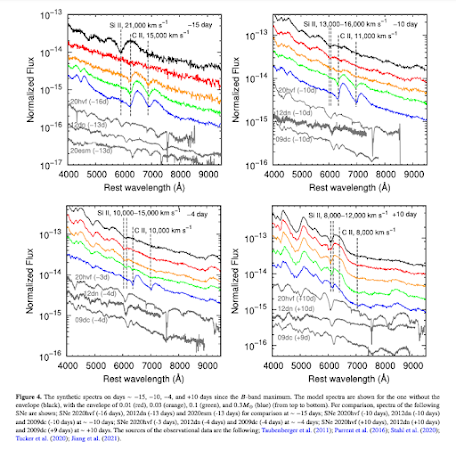
In the present work, we suggest a scenario that provides a unified solution to these peculiarities, through hydrodynamic and radiation transfer simulations together with analytical considerations; a C+O-rich envelope (~0.01 - 0.1 Msun) attached to an exploding WD. Strong C II lines are created within the shocked envelope.
The scenario thus can explain some of the key diverse observational properties by a different amount of the envelope, but additional factors are also required; we argue that the envelope is distributed in a disc-like structure, and also the ejecta properties, e.g., the mass of the WD, plays a key role.
Interestingly, the proposed scenario can also be tested for normal (non overluminous) SNe Ia:
Indeed, by combining the expected properties as summarized above, we can comprehensively test this scenario for SNe Ia with intensive observational coverage from the infant to late phases; the present work thus provides one strong motivation for the high-cadence survey and prompt follow-up observation for SNe Ia of various subclasses, especially nearby events that allow longterm monitoring toward the late phase.
The predicted spectra are shown in Figure 4:


No comments:
Post a Comment