Showing posts with label spectra. Show all posts

Sunday, May 7, 2023

Constraining Type Ia Supernova Progenitors the Apian Way

arXiv:

We present very early photometric and spectroscopic observations of the Type Ia supernova (SN) 2023bee, starting about 8 hours after the explosion, which reveal a strong excess in the optical and nearest UV (U and UVW1) bands during the first several days of explosion.

We find a good match to the Kasen model in which a main-sequence companion star stings the ejecta with a shock as they buzz past. Models of double detonations, shells of radioactive nickel near the surface, interaction with circumstellar material, and pulsational-delayed detonations do not provide good matches to our light curves. We also observe signatures of unburned material, in the form of carbon absorption, in our earliest spectra.

This is an exciting result out of my research group at Las Cumbres Observatory!

Taken together, our observations above suggest that the emission from SN 2023bee during the first few days after explosion consists of typical Type Ia SN spectral features plus an additional hot continuum component. 

This Letter demonstrates the power of using very high-cadence, multiband photometry of young, nearby Type Ia SNe to constrain their progenitor systems, which is only possible with specially designed robotic facilities like the DLT40 Survey, Las Cumbres Observatory, and Swift.  


Previously on this blog:
Tuesday, April 4, 2023

Webb telescope discovers oldest galaxies ever observed

Nature Astronomy:

Here we identify four galaxies located in the JWST Advanced Deep Extragalactic Survey Near-Infrared Camera imaging with photometric redshifts z of roughly 10–13. These galaxies include the first redshift z > 12 systems discovered with distances spectroscopically confirmed by JWST in a companion paper.

Taken together, these measurements show that the first galaxies contributing to cosmic reionization formed rapidly and with intense internal radiation fields.

Phys.org:

The James Webb Space Telescope has discovered the four most distant galaxies ever observed, one of which formed just 320 million years after the Big Bang when the universe was still in its infancy, new research said on Tuesday.

Stephane Charlot, a researcher at the Astrophysics Institute of Paris and co-author of the two new studies, told AFP that the farthest galaxy—called JADES-GS-z13-0—formed 320 million years after the Big Bang. That is the greatest distance ever observed by astronomers, he said.

However in February, the discovery of six massive galaxies from 500-700 million years after the Big Bang led some astronomers to question the standard model.

Those galaxies, also observed by the Webb telescope, were bigger than thought possible so soon after the birth of the universe—if confirmed, the standard model could need updating. 

This analysis does not include even earlier candidates that JWST has discovered that are yet to be confirmed. 

Tuesday, March 14, 2023

Photometry and spectroscopy of the Type Icn supernova 2021ckj: The diverse properties of the ejecta and circumstellar matter of Type Icn SNe

arXiv:

Spectral modeling of SN 2021ckj reveals that its composition is dominated by oxygen, carbon and iron group elements, and the photospheric velocity at peak is ~10000 km/s. From the light curve (LC) modeling applied to SNe 2021ckj, 2019hgp, and 2021csp, we find that the ejecta and CSM properties of Type Icn SNe are diverse.

The similarity of the emission components of these lines implies that the emitting regions of SNe 2021ckj and 2021csp have similar ionization states, and thus suggests that they have similar properties of the ejecta and CSM, which is inferred also from the LC modeling. Taking into account the difference in the strength of the absorption features, this heterogeneity may be attributed to viewing angle effects in otherwise common aspherical ejecta.


Sunday, March 5, 2023

James Webb captures an extremely distant triple-lensed supernova

ESA/Webb:

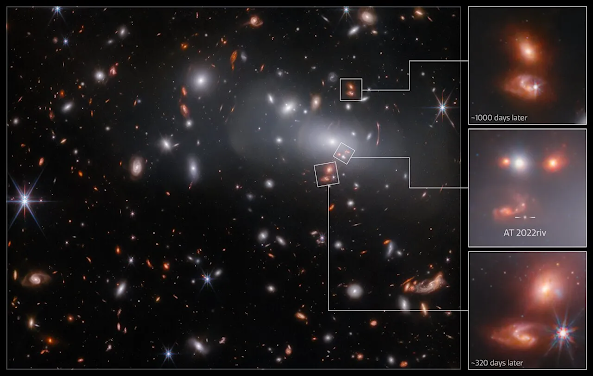
This observation from the NASA/ESA/CSA James Webb Space Telescope contains three different images of the same supernova-hosting galaxy, all of which were created by a colossal gravitational lens. In this case, the lens is the galaxy cluster RX J2129, located around 3.2 billion light-years from Earth in the constellation Aquarius. 

Astronomers discovered the supernova in the triply-lensed background galaxy using observations from the NASA/ESA Hubble Space Telescope, and they suspected that they had found a very distant Type Ia supernova.

SNe Type Ia function as standard candles, so if it really is Type Ia it could be used to determine a cosmic distance to RX J2129. However, I'm curious as to how they made this determination, as I didn't see any conclusive lightcurve or spectra associated with this find. No one has classified the supernova on TNS either. Update: apparently spectroscopy was obtained by NIRSpec but it's not clear if classification was possible.

Digital Trends:

The image features a huge galaxy cluster called RX J2129, located 3.2 billion light-years away, which is acting as a magnifying glass and bending light coming from more distant galaxies behind it. That’s what is causing the stretched-out shape of some of the galaxies toward the top right of the image.

CNET:

Not only does the galaxy appear three times, but it appears at different points in time. A supernova -- a bright exploding star -- is visible in the earliest version of the galaxy. The second and third images, from about 320 days and 1,000 days later, show that the supernova has faded away. An annotated version of the image points out these cool features: 


Mashable:

Astronomers are now adept at spotting the telltale effects of gravitational lensing, but that wasn't always the case. Four decades ago, the concentric arcs of light and stretched celestial objects could be downright confusing. In 1987, an enormous blue arc thought to be hundreds of trillions of miles long was first considered one of the largest objects ever detected in space. The arc was found near the galaxy cluster Abell 370, with another similar object near galaxy cluster 2242-02.

Wednesday, March 1, 2023

Initial Flash and Spectral Formation of Type Ia Supernovae with An Envelope: Applications to Over-luminous SNe Ia

arXiv:

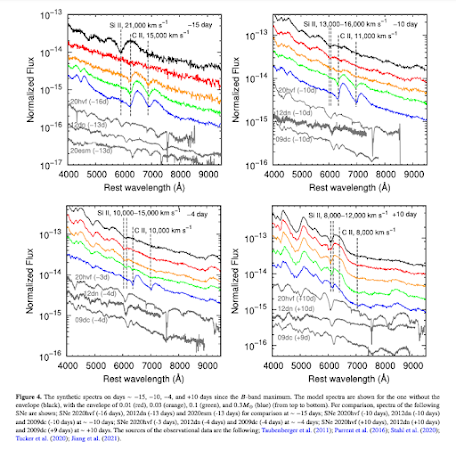
Over-luminous type Ia supernovae (SNe Ia) show peculiar observational features, for which an explosion of a super-massive white dwarf (WD) beyond the classical Chandrasekhar-limiting mass has been suggested, largely based on their high luminosities and slow light-curve evolution.

In the present work, we suggest a scenario that provides a unified solution to these peculiarities, through hydrodynamic and radiation transfer simulations together with analytical considerations; a C+O-rich envelope (~0.01 - 0.1 Msun) attached to an exploding WD. Strong C II lines are created within the shocked envelope.

The scenario thus can explain some of the key diverse observational properties by a different amount of the envelope, but additional factors are also required; we argue that the envelope is distributed in a disc-like structure, and also the ejecta properties, e.g., the mass of the WD, plays a key role.

Interestingly, the proposed scenario can also be tested for normal (non overluminous) SNe Ia:

Indeed, by combining the expected properties as summarized above, we can comprehensively test this scenario for SNe Ia with intensive observational coverage from the infant to late phases; the present work thus provides one strong motivation for the high-cadence survey and prompt follow-up observation for SNe Ia of various subclasses, especially nearby events that allow longterm monitoring toward the late phase.  

The predicted spectra are shown in Figure 4:


The sleep mask that solved my sleep problems

As previously reported on this blog, I've been actively seeking ways to unwind and, in particular, improve my quality of sleep. I've...