Showing posts with label jwst. Show all posts

Friday, February 23, 2024

Neutron star discovered in center of Supernova 1987A

Science:

Editor summary: The nearby supernova SN 1987A was visible to the naked eye, and its evolution has been observed over the ensuing decades. The explosion is thought to have produced a neutron star or black hole, but none has been directly detected. Fransson et al. observed a remnant of SN 1987A using near- and mid-infrared integral field spectroscopy. They identified emission lines of ionized argon that appear only near the center of the remnant. Photoionization models show that the line ratios and velocities can be explained by ionizing radiation from a neutron star illuminating gas from the inner parts of the exploded star

Nature News:

Astronomers used the [JWST] to finally spot signs of an ultradense ‘neutron star’ lurking in the explosion’s core in a galaxy that orbits the Milky Way. Light from the explosion reached Earth 37 years ago this week, in a supernova that revolutionized modern astrophysics by providing an up-close look at how stars die.

JWST did not observe the neutron star directly, because it remains obscured behind a veil of dust from the explosion. But the telescope detected light coming from argon and sulfur atoms that had been ionized, or electrically charged, by radiation blazing from the long-sought neutron star.

Over the years, astronomers watched as rings of gas and dust expanded outwards from the site of the explosion, usually growing dimmer but sometimes brightening when various ejected materials collided.

One outcome of such a supernova is to leave behind a black hole. But early observations of SN 1987A, such as the wave of neutrinos, suggested that it should have given rise to a neutron star, which can be just 20 kilometres across but is so dense that a teaspoonful weighs millions of tonnes.

Space.com:

Using the James Webb Space Telescope (JWST), astronomers have ended a nearly decade-long game of celestial hide-and-seek after they discovered a neutron star in the wreckage of a stellar explosion.

"For a long time, we've been searching for evidence for a neutron star in the gas and dust of Supernova 1987A," Mike Barlow, an emeritus professor of physics and astronomy and part of the team behind this discovery, told Space.com. "Finally, we have the evidence that we've been seeking."

Barlow suggested that researchers may be able to distinguish between a naked neutron star and one clothed by a pulsar-wind nebula by making further infrared observations of the heart of Supernova 1987A with the JWST's NIRSpec instrument.

"We have a program which is gathering data now, which will be getting data with 3 or 4 times the resolution in the near-infrared," he concluded. "So by obtaining these new data, we may be able to distinguish the 2 models that have been proposed to explain the emission powered by a neutron star.


On the Astraveo podcast:
Tuesday, January 2, 2024

JWST Reveals a Surprisingly High Fraction of Galaxies Being Spiral-like

arXiv:

In this letter, we used James Webb Space Telescope (JWST) images from the Cosmic Evolution Early Release Science Survey to visually identify spiral galaxies with redshift 0.5≤z≤4 and stellar mass ≥1010M⊙. Out of 873 galaxies, 216 were found to have a spiral structure.

These fractions are higher than the fractions observed with the Hubble Space Telescope (HST). We even detect possible spiral-like features at redshifts z>3.

This fraction is surprisingly high and implies that the formation of spiral arms, as well as disks, was earlier in the universe. 

Phys.org:

Of these galaxies, 216 were classified as spirals. The authors were careful to note that some may be merging galaxies that were misclassified, but even then 108 of the galaxies were unanimously classified as spirals by evaluators. When the team arranged them by redshift, they found that while the fraction of spirals decreased as you went further into the past, the fraction of spirals at redshifts above z = 3 was much higher than expected. When the team calibrated observations, they found about a fifth of galaxies at z = 3 are spiral galaxies. These very early galaxies would have had to become spirals less than two billion years after the Big Bang, meaning that there would have been little time for mergers and collisions to be the cause.

If spiral galaxies were more common in the early universe than expected, it could indicate that certain conditions or mechanisms favored the formation of spiral structures at that time. This is quite at odds with the current understanding of what structures were favored during these early epochs of the Universe's development.


Previously on this blog:

Tuesday, April 4, 2023

Webb telescope discovers oldest galaxies ever observed

Nature Astronomy:

Here we identify four galaxies located in the JWST Advanced Deep Extragalactic Survey Near-Infrared Camera imaging with photometric redshifts z of roughly 10–13. These galaxies include the first redshift z > 12 systems discovered with distances spectroscopically confirmed by JWST in a companion paper.

Taken together, these measurements show that the first galaxies contributing to cosmic reionization formed rapidly and with intense internal radiation fields.

Phys.org:

The James Webb Space Telescope has discovered the four most distant galaxies ever observed, one of which formed just 320 million years after the Big Bang when the universe was still in its infancy, new research said on Tuesday.

Stephane Charlot, a researcher at the Astrophysics Institute of Paris and co-author of the two new studies, told AFP that the farthest galaxy—called JADES-GS-z13-0—formed 320 million years after the Big Bang. That is the greatest distance ever observed by astronomers, he said.

However in February, the discovery of six massive galaxies from 500-700 million years after the Big Bang led some astronomers to question the standard model.

Those galaxies, also observed by the Webb telescope, were bigger than thought possible so soon after the birth of the universe—if confirmed, the standard model could need updating. 

This analysis does not include even earlier candidates that JWST has discovered that are yet to be confirmed. 

Sunday, March 5, 2023

James Webb captures an extremely distant triple-lensed supernova

ESA/Webb:

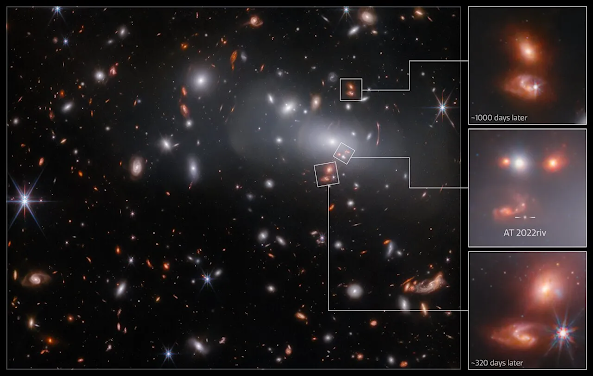
This observation from the NASA/ESA/CSA James Webb Space Telescope contains three different images of the same supernova-hosting galaxy, all of which were created by a colossal gravitational lens. In this case, the lens is the galaxy cluster RX J2129, located around 3.2 billion light-years from Earth in the constellation Aquarius. 

Astronomers discovered the supernova in the triply-lensed background galaxy using observations from the NASA/ESA Hubble Space Telescope, and they suspected that they had found a very distant Type Ia supernova.

SNe Type Ia function as standard candles, so if it really is Type Ia it could be used to determine a cosmic distance to RX J2129. However, I'm curious as to how they made this determination, as I didn't see any conclusive lightcurve or spectra associated with this find. No one has classified the supernova on TNS either. Update: apparently spectroscopy was obtained by NIRSpec but it's not clear if classification was possible.

Digital Trends:

The image features a huge galaxy cluster called RX J2129, located 3.2 billion light-years away, which is acting as a magnifying glass and bending light coming from more distant galaxies behind it. That’s what is causing the stretched-out shape of some of the galaxies toward the top right of the image.

CNET:

Not only does the galaxy appear three times, but it appears at different points in time. A supernova -- a bright exploding star -- is visible in the earliest version of the galaxy. The second and third images, from about 320 days and 1,000 days later, show that the supernova has faded away. An annotated version of the image points out these cool features: 


Mashable:

Astronomers are now adept at spotting the telltale effects of gravitational lensing, but that wasn't always the case. Four decades ago, the concentric arcs of light and stretched celestial objects could be downright confusing. In 1987, an enormous blue arc thought to be hundreds of trillions of miles long was first considered one of the largest objects ever detected in space. The arc was found near the galaxy cluster Abell 370, with another similar object near galaxy cluster 2242-02.

Saturday, February 25, 2023

Webb telescope spots super old, massive galaxies that shouldn’t exist

Nature:

Here we make use of the 1-5 μm coverage of the JWST early release observations to search for intrinsically red galaxies in the first ≈ 750 million years of cosmic history. In the survey area, we find six candidate massive galaxies (stellar mass > 1010 solar masses) at 7.4 ≤ z ≤ 9.1, 500–700 Myr after the Big Bang, including one galaxy with a possible stellar mass of ~1011 solar masses.

If verified with spectroscopy, the stellar mass density in massive galaxies would be much higher than anticipated from previous studies based on rest-frame ultraviolet-selected samples.

They posit two scenarios:

We infer that the possible interpretation of these JWST-identified “optical break galaxies” falls between two extremes. If the redshifts and fiducial masses are correct, then the mass density in the most massive galaxies would exceed the total previously estimated mass density...

The other extreme interpretation is that all the fiducial masses are larger than the true masses by factors of >10-100.

It will be extremely exciting to see if these mass density estimates are validated.

CU Boulder:

In a new study, an international team of astrophysicists has discovered several mysterious objects hiding in images from the James Webb Space Telescope: six potential galaxies that emerged so early in the universe’s history and are so massive they should not be possible under current cosmological theory.

“It’s bananas,” said Erica Nelson, co-author of the new research and assistant professor of astrophysics at CU Boulder. “You just don’t expect the early universe to be able to organize itself that quickly. These galaxies should not have had time to form.”

She explained that in astronomy, red light usually equals old light. The universe, Nelson said, has been expanding since the dawn of time. As it expands, galaxies and other celestial objects move farther apart, and the light they emit stretches out—think of it like the cosmic equivalent of saltwater taffy. The more the light stretches, the redder it looks to human instruments. (Light from objects coming closer to Earth, in contrast, looks bluer)...The team ran calculations and discovered that their old galaxies were also huge, harboring tens to hundreds of billions of sun-sized stars worth of mass, on par with the Milky Way.

Mashable:

While scanning a region of the cosmos near the Big Dipper, a group of astronomers identified six faint objects as they appeared well over 13 billion years ago. They suspect the objects are ancient galaxies. Scientists expect such early collections of stars and swirling matter to be relatively small. After all, such galaxies hadn't had much time to form or grow. But these galaxies are giants, the researchers report.

"If even one of these galaxies is real, it will push against the limits of our understanding of cosmology,” Nelson noted.


Tuesday, February 14, 2023

Carbonaceous dust grains within galaxies seen in the first billion years of cosmic time

 arXiv:

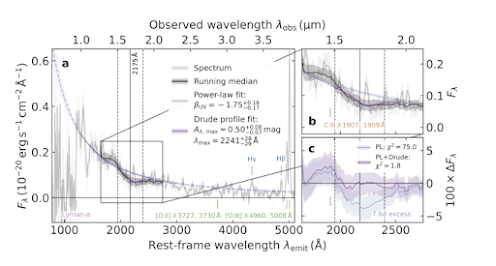
Interstellar dust captures a significant fraction of elements heavier than helium in the solid state and is an indispensable component both in theory and observations of galaxy evolution. However, the astrophysical origin of various types of dust grains remains an open question, especially in the early Universe. Here we report direct evidence for the presence of carbonaceous grain from the detection of the broad UV absorption feature around 2175 Å in deep near-infrared spectra of galaxies up to the first billion years of cosmic time, at a redshift (𝑧) of ∼ 7. 

Our results suggest a more rapid production scenario, likely in supernova (SN) ejecta.

The previous scenario considered was giant branch/AGB stellar evolution. There are some issues with the supernova scenario, particularly in that supernova shock waves tend to vaporize surrounding dust grains produced in previous phases.

Figure 1. Spectrum taken by JWST/NIRSpec of JADES-GS-z6-0 at redshift z = 6.71. a...


I like this figure a lot--it shows the UV bump around 2000 Å extremely clearly.


The sleep mask that solved my sleep problems

As previously reported on this blog, I've been actively seeking ways to unwind and, in particular, improve my quality of sleep. I've...