Showing posts with label astraveo. Show all posts

Tuesday, February 27, 2024

Thermal vacuum testing for the Europa Clipper

NASA (via YouTube):

We'll be back soon. The spacecraft is currently undergoing vacuum testing.

I was a huge fan of the livestream for building the Perseverance rover--I'm glad they've got another one running for Clipper. It's fun to check in on the progress of the build and try to guess what they're working on at any given moment. 

Astrobiology.com:

Scheduled to launch in October 2024 and arrive in the Jupiter system in 2030, NASA’s Europa Clipper mission will place a spacecraft in orbit around Jupiter to perform a detailed investigation of Europa.

This will maximize the scientific return from the lifetime of Europa Clipper, which is investigating the “habitability” of Europa. Habitability is a measure of whether Europa could support life and includes the presence of essential ingredients like liquid water, chemical building blocks and an energy source.

“Europa is considered one of the most likely sites in our solar system to potentially find life,” said SwRI Lead Scientist Dr. Kelly Miller.

Phys.org:

Today is a big day for the Europa Clipper team. They'll be testing the craft's thermal pumping system, the last major addition to the spacecraft's vault, a thick-walled aluminum alloy box that holds the spacecraft's "brain": its electronics and computers.

"The thermal pump is the heart of the spacecraft," pumping fluid through tubing to control the craft's temperature, Barajas said. The daylong effort is hazardous because of the high pressure used to test the system with helium, a nonflammable gas.

"Planetary protection has evolved," Barajas said of the strict work requirements he has to follow every day. "No one wants to be the person responsible when extra-terrestrial life is finally found and it turns out to be something we brought there from earth."

"I think that's where the stress comes from, right? That we feel the pressure and the burden of building this vehicle that has been the life's work of some and years of work for many others."

I'll continue updating this thread with news of the Europa Clipper development. 


Friday, February 23, 2024

Neutron star discovered in center of Supernova 1987A

Science:

Editor summary: The nearby supernova SN 1987A was visible to the naked eye, and its evolution has been observed over the ensuing decades. The explosion is thought to have produced a neutron star or black hole, but none has been directly detected. Fransson et al. observed a remnant of SN 1987A using near- and mid-infrared integral field spectroscopy. They identified emission lines of ionized argon that appear only near the center of the remnant. Photoionization models show that the line ratios and velocities can be explained by ionizing radiation from a neutron star illuminating gas from the inner parts of the exploded star

Nature News:

Astronomers used the [JWST] to finally spot signs of an ultradense ‘neutron star’ lurking in the explosion’s core in a galaxy that orbits the Milky Way. Light from the explosion reached Earth 37 years ago this week, in a supernova that revolutionized modern astrophysics by providing an up-close look at how stars die.

JWST did not observe the neutron star directly, because it remains obscured behind a veil of dust from the explosion. But the telescope detected light coming from argon and sulfur atoms that had been ionized, or electrically charged, by radiation blazing from the long-sought neutron star.

Over the years, astronomers watched as rings of gas and dust expanded outwards from the site of the explosion, usually growing dimmer but sometimes brightening when various ejected materials collided.

One outcome of such a supernova is to leave behind a black hole. But early observations of SN 1987A, such as the wave of neutrinos, suggested that it should have given rise to a neutron star, which can be just 20 kilometres across but is so dense that a teaspoonful weighs millions of tonnes.

Space.com:

Using the James Webb Space Telescope (JWST), astronomers have ended a nearly decade-long game of celestial hide-and-seek after they discovered a neutron star in the wreckage of a stellar explosion.

"For a long time, we've been searching for evidence for a neutron star in the gas and dust of Supernova 1987A," Mike Barlow, an emeritus professor of physics and astronomy and part of the team behind this discovery, told Space.com. "Finally, we have the evidence that we've been seeking."

Barlow suggested that researchers may be able to distinguish between a naked neutron star and one clothed by a pulsar-wind nebula by making further infrared observations of the heart of Supernova 1987A with the JWST's NIRSpec instrument.

"We have a program which is gathering data now, which will be getting data with 3 or 4 times the resolution in the near-infrared," he concluded. "So by obtaining these new data, we may be able to distinguish the 2 models that have been proposed to explain the emission powered by a neutron star.


On the Astraveo podcast:

Astronomers spot new tiny moons around Neptune and Uranus

Carnegie Science:  

The Solar System has some new lunar members—the first new moon of Uranus discovered in more than 20 years, and likely the smallest, as well as two new moons of Neptune, one of which is the faintest moon ever discovered by ground-based telescopes.

“The three newly discovered moons are the faintest ever found around these two ice giant planets using ground-based telescopes,” explained Carnegie astronomer Scott S. Sheppard. “It took special image processing to reveal such faint objects.” 

Discovering all three of the new moons required taking dozens of five-minute exposures over three- or four-hour periods on a series of nights. These exposures were shifted by the apparent motion of each respective planet and added together to create one very deep image. Using this time intensive observing technique on some of the largest telescopes in the world allowed the survey images to go deeper than any previous observations near Uranus and Neptune.

Follow-up observations on the Magellan telescopes in October of 2021 and again in 2022 and November 2023 confirmed the brighter Neptunian moon as orbiting Neptune.

NBC:

Astronomers have found three previously unknown moons in our solar system — two additional moons circling Neptune and one around Uranus.

The latest tally puts Neptune at 16 known moons and Uranus at 28.

One of Neptune’s new moons has the longest known orbital journey yet. It takes around 27 years for the small outer moon to complete one lap around Neptune.

Space.com:

Uranus' new moon, the first detected around the ice giant in over two decades and possibly the smallest of its ilk, is just 5 miles (8 kilometers) wide; it takes 680 days to complete one orbit around Uranus. In comparison, one Mars' moons named Deimos, considered to be among the tiniest known moons in our solar system, is 8 miles (13 km) wide. 

The discovery was made using observatories in Hawaii and Chile by Scott Sheppard, a staff scientist at Carnegie Science, in collaboration with Marina Brozovic and Bob Jacobson of NASA's Jet Propulsion Laboratory (JPL), David Tholen of the University of Hawaii, Chad Trujillo of Northern Arizona University and Patryk Sofia Lykawa of Kindai University.


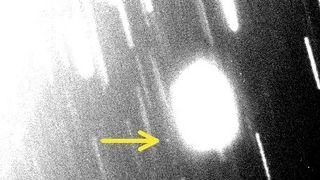
One of the discovery images shows how insanely faint the moon is compared to Uranus itself (already a very dim object from Earth):

a black and white, blurry image with lots of white streaks. There is a white blob in the center-right. To the very left of thto which a yellow arrow is pointing.
The discovery image of the new Uranian moon S/2023 U1 using the Magellan telescope on November 4, 2023. Uranus is just off the field of view in the upper left, as seen by the increased scattered light. S/2023 U1 is the faint point of light in the center of the image. (Image credit: Scott Sheppard)


On the Astraveo podcast:

Thursday, January 4, 2024

Coronal mass ejection from colossal New Year's Eve solar flare will strike Earth today

Space.com:

The coronal mass ejection CME was hurled into space by an X-class solar flare that burst from the surface of the sun at 4:55 p.m. EST (2155 GMT) on Sunday (Dec. 31). It is the most powerful flare that has happened on the sun during the current solar cycle, solar cycle 25, which began in Dec. 2019. In fact, the flare that ended 2023 with a bang is the largest that has been observed since Sept. 10, 2017, according to the Space Weather Prediction Center of the National Oceanic And Atmospheric Administration (NOAA).

I'm always amused by these comparisons articles like to make. "Largest that has been observed since 2017". We're approaching solar maximum so the flares will be the largest in the cycle. The solar cycle is ~11 years so the last maximum was in the early 2010s, and the last minimum was in the late 2010s. "This solar flare at near maximum was bigger than the ones at the minimum" has substantially less punch.

Storms like this have the capability to cause weak fluctuations in power grids and could have minor impacts on satellite operations. In addition to this, G1 geomagnetic storms can give rise to striking auroras, beautiful light shows seen over Earth, usually at higher latitudes.

In 2003, during the last solar maximum — the peak of the sun's activity during the solar cycle 24  — an X45 flare was seen erupting from the sun, the most powerful solar flare ever measured. 

A powerful X-class flare like the one seen on New Year's Eve has the potential for long-lasting radiation storms, which can damage satellites, including GPS, and affect aircraft flying near the poles of Earth, even giving passengers on these flights small radiation doses. X flares also have the potential to cause worldwide blackouts, if conditions were just right.

The Hill:

In an update Sunday evening, NOAA’s Space Weather Prediction Center (SWPC) released an image of the flare, which appeared as a large, glowing spot on the sun. You can see that image below. 


Image reproduced from thehill.com. Original caption: An X5 solar flare detected by NOAA’s Space Weather Prediction Center on December 31, 2023. (NOAA SWPC; cropped)

At an X5, Sunday’s flare was much smaller than the flare recorded in 2003. It was, however, the strongest since September 2017, when an X8.2 flare was detected, according to the SWPC. This flare also supersedes an X2.8 solar flare reported in the same region of the sun on December 14. At the time, the SWPC reported that flare was “likely one of the largest solar radio events ever recorded.”

Possible effects:

The SWPC said those using high-frequency radio signals (like emergency managers) may notice a “temporary degradation or complete loss of signal on much of the sunlit side of Earth” as a result of Sunday’s solar flare.


Previously on this blog:


Wednesday, January 3, 2024

New ultra-short period binary discovered

arXiv:

Binary evolution theory predicts that the second common envelope (CE) ejection can produce low-mass (0.32-0.36 Msun) subdwarf B (sdB) stars inside ultrashort-orbital-period binary systems, as their helium cores are ignited under nondegenerate conditions.

Here we report the discovery of a 20.5-minute-orbital-period ellipsoidal binary, TMTS J052610.43+593445.1, in which the visible star is being tidally deformed by an invisible carbon-oxygen white dwarf (WD) companion. 

phys.org:

The orbital periods of such detached sdB binary systems can be as short as 20 minutes. However, to date only four binaries of this type with orbital periods below one hour have been found.

Now, a team of astronomers led by Jie Lin of the Tsinghua University in Beijing, China, reports the detection of a new sdB binary with an extremely short orbital period...they discovered a dozen such objects, and one of them, which received designation TMTS J052610.43+593445.1 (or J0526 for short) turned out to be an sdB binary with an orbital period of approximately 20.5 minutes.

BNN Breaking:

The white dwarf, although ten times smaller than the sun, has a mass of 0.735 solar masses and an effective temperature of 25,400 K. This binary system presents astronomers with a unique opportunity to study the physics and evolution of stars under extreme conditions.

In about 1.5 million years, the subdwarf will begin transferring mass to the white dwarf at an even shorter orbital period, leading to the formation of an AM CVn star through the helium-star channel. This process is pivotal for understanding binary evolution from the second common envelope ejection to the formation of AM CVn stars. The discovery of TMTS J052610.43+593445.1 could play a significant role in investigating these binary evolution paths.


Previously on this blog:

Tuesday, January 2, 2024

JWST Reveals a Surprisingly High Fraction of Galaxies Being Spiral-like

arXiv:

In this letter, we used James Webb Space Telescope (JWST) images from the Cosmic Evolution Early Release Science Survey to visually identify spiral galaxies with redshift 0.5≤z≤4 and stellar mass ≥1010M⊙. Out of 873 galaxies, 216 were found to have a spiral structure.

These fractions are higher than the fractions observed with the Hubble Space Telescope (HST). We even detect possible spiral-like features at redshifts z>3.

This fraction is surprisingly high and implies that the formation of spiral arms, as well as disks, was earlier in the universe. 

Phys.org:

Of these galaxies, 216 were classified as spirals. The authors were careful to note that some may be merging galaxies that were misclassified, but even then 108 of the galaxies were unanimously classified as spirals by evaluators. When the team arranged them by redshift, they found that while the fraction of spirals decreased as you went further into the past, the fraction of spirals at redshifts above z = 3 was much higher than expected. When the team calibrated observations, they found about a fifth of galaxies at z = 3 are spiral galaxies. These very early galaxies would have had to become spirals less than two billion years after the Big Bang, meaning that there would have been little time for mergers and collisions to be the cause.

If spiral galaxies were more common in the early universe than expected, it could indicate that certain conditions or mechanisms favored the formation of spiral structures at that time. This is quite at odds with the current understanding of what structures were favored during these early epochs of the Universe's development.


Previously on this blog:

How many planets could be in the Kuiper Belt?

ApJL: 

Motivated by recent measurements of the free-floating-planet mass function at terrestrial masses, we consider the possibility that the solar system may have captured a terrestrial planet early in its history. We show that ∼1.2 captured free-floating planets with mass strictly greater than that of Mars may exist in the outer solar system, with a median predicted distance of ∼1400 au.

To evaluate the expected mass of the most massive captured free-floating planet as a function of the maximum semimajor axis, given the arguments presented in Section 2, we implement a Monte Carlo simulation.

This is an interesting calculation, but the result of ~1 free-floating planet does not have a reported error and seems extremely sensitive to the mass function. Equation 1 gives the mass function of free-forming planets:

The coefficient on the power-law term has substantial errorbars, changing the result of the mass function by up to 75% if alpha ~ 1. Examining alpha as well, the paper reports that alpha ~ 0.96 \pm 0.47, which would have a substantial effect on the value of the mass function. It wasn't immediately clear how this substantial variation affected the number of planets detected. Figure 1 shows the confidence intervals on the mass estimate for a planet of abundance unity, but I wasn't able to immediately grasp how to convert this into an errorbar on the planet abundance estimate. Then Figure 2 shows the cumulative fraction and expected number of captured free-floating planets, but doesn't show the confidence intervals. So overall, it's hard to assess the free-floating planet abundance estimate from their simulations given the huge spread on the parameters. The estimate changes from ~1 to ~3 with a change of binning, which is expected but also highlights how uncertain the estimate and approach are, so it would been interesting to see a more thorough exploration of this.

Phys.org:

A recent study published in the Astrophysical Journal Letters investigates the potential existence of Mars-sized free-floating planets (FFPs)—also known as rogue planets, starless planets, and wandering planets—that could have been captured by our sun's gravity long ago and orbit in the outer solar system approximately 1,400 astronomical units (AU) from the sun.

Scientists currently hypothesize that rogue planets are formed from two scenarios: As part of their own solar system but are then somehow ejected into the cosmos, or they form in isolation. But what is the significance of studying free-floating planets, overall?

After conducting approximately 100,000,000 simulations, the results indicate the potential for the existence of a Mars-sized, or even a Mercury-sized planetary body somewhere in the outer solar system approximately 1,400 AU from the Sun.

Universe Today:

Siraj recommends in his study that future work could include gaining greater understanding of how rogue planets are captured in the first place, along with investigating observational tests to identify where to look in the sky for rogue planets, as well. He also notes how microlensing has become the preferred method in identifying rogue planets based on past studies.

Rogue planet capture is extremely interesting for sure. I'm also super interested in the related phenomenon of JuMBOs (Jupiter-Mass Binary Objects), which are forcing astrophysicists to confront the same tough questions as this study.


Previously on this blog:

Monday, November 20, 2023

Detection of long-lasting aurora-like radio emission above a sunspot

nature astronomy:

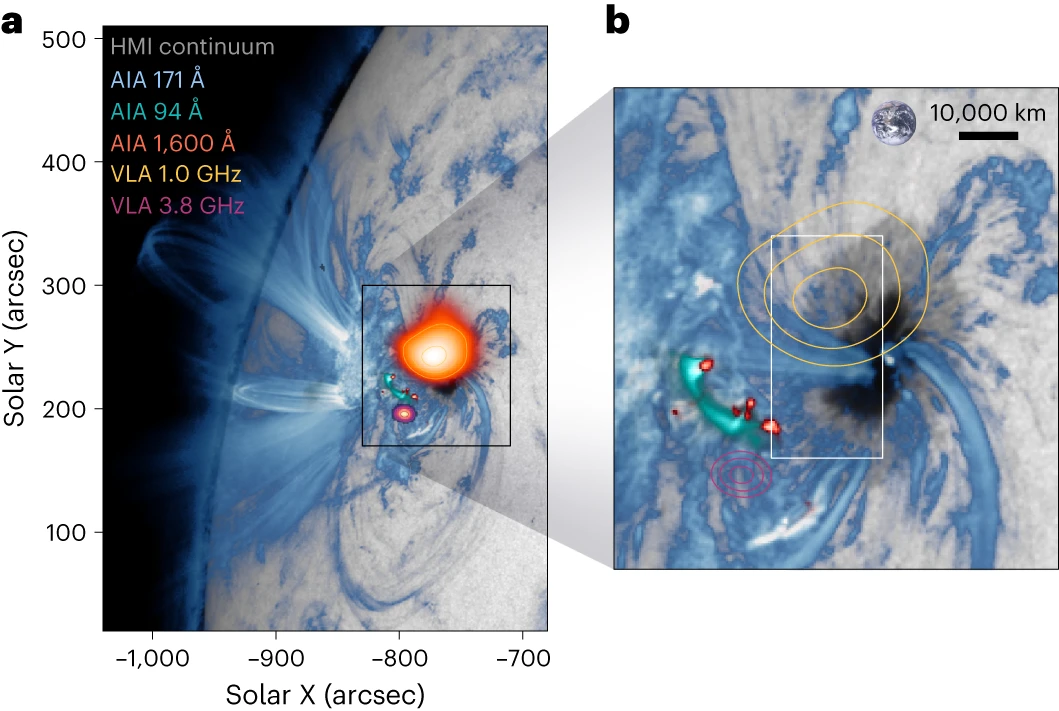
Here we report observations of long-lasting solar radio bursts with high brightness temperature, wide bandwidth and high circular polarization fraction akin to these auroral and exo-auroral radio emissions, albeit two to three orders of magnitude weaker than those on certain low-mass stars. Spatially, spectrally and temporally resolved analysis suggests that the source is located above a sunspot where a strong, converging magnetic field is present. 

Our findings offer new insights into the origin of such intense solar radio bursts and may provide an alternative explanation for aurora-like radio emissions on other flare stars with large starspots.


(Figure 1 caption) a, Example of a VLA snapshot image at 1.0 GHz (orange) of the radio emission from the sunspot with the image of the radio-hosting NOAA 12529 AR observed in EUV wavelengths by the AIA, 171 Å (blue), 94 Å (cyan) and 1,600 Å (red) overlaid on the photospheric image observed by the HMI aboard the SDO. Also shown is a VLA 3.8 GHz image (magenta) of the radio emission from the flare site. b, Closer view of the sunspot region (box in a). The 1.0 GHz and 3.8 GHz are shown as yellow and magenta contours, respectively, at 50%, 70% and 90% of the maximum. The white box in b is discussed further at Fig. 4.

LiveScience:

Scientists have spotted a stunning "aurora-like" display of crackling radio waves over the surface of the sun that is strikingly similar to the Northern Lights on Earth. 

"This is quite unlike the typical, transient solar radio bursts typically lasting minutes or hours," lead author Sijie Yu, an astronomer at New Jersey Institute of Technology's Center for Solar-Terrestrial Research (NJIT-CSTR), said in a statement. "It's an exciting discovery that has the potential to alter our comprehension of stellar magnetic processes."

The researchers say their discovery has opened up new ways to study the sun's activity, and they have begun poring through archival data to find hidden evidence of past solar auroras. "We're beginning to piece together the puzzle of how energetic particles and magnetic fields interact in a system with the presence of long-lasting starspots," study co-author Surajit Mondal, a solar physicist at NJIT, said in the statement. "Not just on our own Sun but also on stars far beyond our solar system."

This is a really exciting discovery! The resolution required to do this kind of work is fairly low so it seems completely plausible that past observations of the Sun in radio may have captured these sorts of effects. The duration is also interesting--a week is a long time for solar processes. Something I'm particularly curious about is whether we expect to see more of these now that a long and early solar maximum is just around the corner.

NOAA:

NOAA’s Space Weather Prediction Center (SWPC) issued a revised prediction for solar activity during Solar Cycle 25 that concludes solar activity will increase more quickly and peak at a higher level than that predicted by an expert panel in December 2019. The updated prediction now calls for Solar Cycle 25 to peak between January and October of 2024, with a maximum sunspot number between 137 and 173.

The solar maximum is a period in the solar cycle when the Sun's activity, particularly in terms of sunspots and solar flares, is at its highest. The solar cycle is an approximately 11-year cycle during which the Sun undergoes a regular pattern of changes in solar activity. This cycle is characterized by the waxing and waning of the number of sunspots on the Sun's surface.

During solar maximum, the number of sunspots is at its peak, and solar activity is generally more intense. Sunspots are temporary phenomena on the Sun's photosphere that appear as spots darker than the surrounding areas. They are associated with strong magnetic activity and are often the source of solar flares and coronal mass ejections (CMEs). It therefore seems pretty reasonable to me that we might expect more of these aurora-like transients, which seemed to form above a large sunspot.


Previously on this blog:

ALMA Achieve Unprecedented Resolution to Observe the Universe

ALMA Observatory:

An international team of astronomers and engineers has successfully conducted an observation that achieved an extraordinary resolution of 5 milliarcseconds, using ALMA's highest frequency Band 10 receiver and an array configuration that spans 16 kilometers. 

This groundbreaking observation allowed the team to capture unprecedented details of a maser around an evolved star within the Milky Way. 

Yoshiharu Asaki, the ALMA Astronomer who led this project, highlighted the collaborative effort: "This remarkable achievement in high-resolution imaging through ALMA's advanced capabilities marks a significant milestone in our quest to understand the Universe. The success of the Band 10 high-resolution observation showcases our commitment to innovation and reinforces ALMA's position as a leader in astronomical discovery. We are excited about the new possibilities for the scientific community."

5 milliarcseconds is certainly an impressive resolution. For comparison, the VLBI array that examined SN 1993J at 8 GHz achieved a resolution of ~1 milliarcsecond. For a single station to achieve this is incredible.

ApJ:

The Atacama Large Millimeter/submillimeter Array (ALMA) was used in 2021 to image the carbon-rich evolved star R Lep in Bands 8–10 (397–908 GHz) with baselines up to 16 km. The goal was to validate the calibration...and the imaging procedures required to obtain the maximum angular resolution achievable with ALMA.

It's quite interesting seeing that the paper is very focused on what amounts to a test and validation of the capabilities of ALMA, but still got good coverage in the media. This isn't a bad thing at all--usually buzzwordy science results grab all the attention--and it's nice to see a shift towards interest in some of the technical aspects of the field.


The Soul of an Octopus by Sy Montgomery

Sy Montgomery : In this astonishing book from the author of the bestselling memoir, The Good Good Pig, Sy Montgomery explores the emotional ...