Showing posts with label solar. Show all posts

Thursday, January 4, 2024

Coronal mass ejection from colossal New Year's Eve solar flare will strike Earth today

Space.com:

The coronal mass ejection CME was hurled into space by an X-class solar flare that burst from the surface of the sun at 4:55 p.m. EST (2155 GMT) on Sunday (Dec. 31). It is the most powerful flare that has happened on the sun during the current solar cycle, solar cycle 25, which began in Dec. 2019. In fact, the flare that ended 2023 with a bang is the largest that has been observed since Sept. 10, 2017, according to the Space Weather Prediction Center of the National Oceanic And Atmospheric Administration (NOAA).

I'm always amused by these comparisons articles like to make. "Largest that has been observed since 2017". We're approaching solar maximum so the flares will be the largest in the cycle. The solar cycle is ~11 years so the last maximum was in the early 2010s, and the last minimum was in the late 2010s. "This solar flare at near maximum was bigger than the ones at the minimum" has substantially less punch.

Storms like this have the capability to cause weak fluctuations in power grids and could have minor impacts on satellite operations. In addition to this, G1 geomagnetic storms can give rise to striking auroras, beautiful light shows seen over Earth, usually at higher latitudes.

In 2003, during the last solar maximum — the peak of the sun's activity during the solar cycle 24  — an X45 flare was seen erupting from the sun, the most powerful solar flare ever measured. 

A powerful X-class flare like the one seen on New Year's Eve has the potential for long-lasting radiation storms, which can damage satellites, including GPS, and affect aircraft flying near the poles of Earth, even giving passengers on these flights small radiation doses. X flares also have the potential to cause worldwide blackouts, if conditions were just right.

The Hill:

In an update Sunday evening, NOAA’s Space Weather Prediction Center (SWPC) released an image of the flare, which appeared as a large, glowing spot on the sun. You can see that image below. 


Image reproduced from thehill.com. Original caption: An X5 solar flare detected by NOAA’s Space Weather Prediction Center on December 31, 2023. (NOAA SWPC; cropped)

At an X5, Sunday’s flare was much smaller than the flare recorded in 2003. It was, however, the strongest since September 2017, when an X8.2 flare was detected, according to the SWPC. This flare also supersedes an X2.8 solar flare reported in the same region of the sun on December 14. At the time, the SWPC reported that flare was “likely one of the largest solar radio events ever recorded.”

Possible effects:

The SWPC said those using high-frequency radio signals (like emergency managers) may notice a “temporary degradation or complete loss of signal on much of the sunlit side of Earth” as a result of Sunday’s solar flare.


Previously on this blog:


Monday, November 20, 2023

Detection of long-lasting aurora-like radio emission above a sunspot

nature astronomy:

Here we report observations of long-lasting solar radio bursts with high brightness temperature, wide bandwidth and high circular polarization fraction akin to these auroral and exo-auroral radio emissions, albeit two to three orders of magnitude weaker than those on certain low-mass stars. Spatially, spectrally and temporally resolved analysis suggests that the source is located above a sunspot where a strong, converging magnetic field is present. 

Our findings offer new insights into the origin of such intense solar radio bursts and may provide an alternative explanation for aurora-like radio emissions on other flare stars with large starspots.


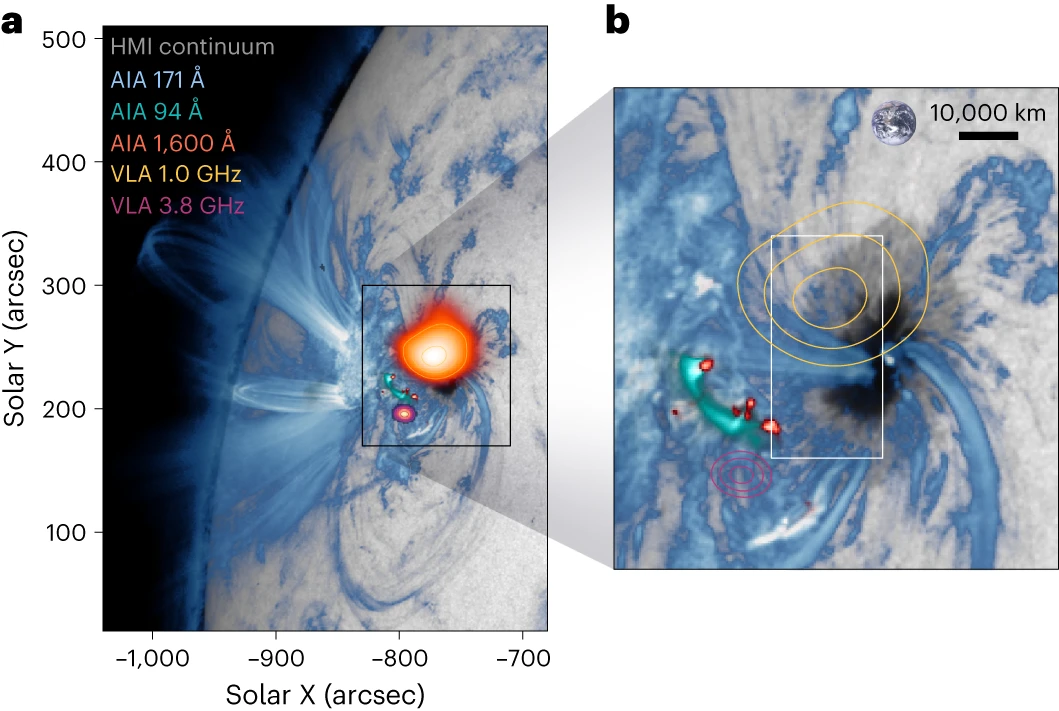
(Figure 1 caption) a, Example of a VLA snapshot image at 1.0 GHz (orange) of the radio emission from the sunspot with the image of the radio-hosting NOAA 12529 AR observed in EUV wavelengths by the AIA, 171 Å (blue), 94 Å (cyan) and 1,600 Å (red) overlaid on the photospheric image observed by the HMI aboard the SDO. Also shown is a VLA 3.8 GHz image (magenta) of the radio emission from the flare site. b, Closer view of the sunspot region (box in a). The 1.0 GHz and 3.8 GHz are shown as yellow and magenta contours, respectively, at 50%, 70% and 90% of the maximum. The white box in b is discussed further at Fig. 4.

LiveScience:

Scientists have spotted a stunning "aurora-like" display of crackling radio waves over the surface of the sun that is strikingly similar to the Northern Lights on Earth. 

"This is quite unlike the typical, transient solar radio bursts typically lasting minutes or hours," lead author Sijie Yu, an astronomer at New Jersey Institute of Technology's Center for Solar-Terrestrial Research (NJIT-CSTR), said in a statement. "It's an exciting discovery that has the potential to alter our comprehension of stellar magnetic processes."

The researchers say their discovery has opened up new ways to study the sun's activity, and they have begun poring through archival data to find hidden evidence of past solar auroras. "We're beginning to piece together the puzzle of how energetic particles and magnetic fields interact in a system with the presence of long-lasting starspots," study co-author Surajit Mondal, a solar physicist at NJIT, said in the statement. "Not just on our own Sun but also on stars far beyond our solar system."

This is a really exciting discovery! The resolution required to do this kind of work is fairly low so it seems completely plausible that past observations of the Sun in radio may have captured these sorts of effects. The duration is also interesting--a week is a long time for solar processes. Something I'm particularly curious about is whether we expect to see more of these now that a long and early solar maximum is just around the corner.

NOAA:

NOAA’s Space Weather Prediction Center (SWPC) issued a revised prediction for solar activity during Solar Cycle 25 that concludes solar activity will increase more quickly and peak at a higher level than that predicted by an expert panel in December 2019. The updated prediction now calls for Solar Cycle 25 to peak between January and October of 2024, with a maximum sunspot number between 137 and 173.

The solar maximum is a period in the solar cycle when the Sun's activity, particularly in terms of sunspots and solar flares, is at its highest. The solar cycle is an approximately 11-year cycle during which the Sun undergoes a regular pattern of changes in solar activity. This cycle is characterized by the waxing and waning of the number of sunspots on the Sun's surface.

During solar maximum, the number of sunspots is at its peak, and solar activity is generally more intense. Sunspots are temporary phenomena on the Sun's photosphere that appear as spots darker than the surrounding areas. They are associated with strong magnetic activity and are often the source of solar flares and coronal mass ejections (CMEs). It therefore seems pretty reasonable to me that we might expect more of these aurora-like transients, which seemed to form above a large sunspot.


Previously on this blog:

The sleep mask that solved my sleep problems

As previously reported on this blog, I've been actively seeking ways to unwind and, in particular, improve my quality of sleep. I've...