Showing posts with label moon. Show all posts

Friday, February 23, 2024

Astronomers spot new tiny moons around Neptune and Uranus

Carnegie Science:  

The Solar System has some new lunar members—the first new moon of Uranus discovered in more than 20 years, and likely the smallest, as well as two new moons of Neptune, one of which is the faintest moon ever discovered by ground-based telescopes.

“The three newly discovered moons are the faintest ever found around these two ice giant planets using ground-based telescopes,” explained Carnegie astronomer Scott S. Sheppard. “It took special image processing to reveal such faint objects.” 

Discovering all three of the new moons required taking dozens of five-minute exposures over three- or four-hour periods on a series of nights. These exposures were shifted by the apparent motion of each respective planet and added together to create one very deep image. Using this time intensive observing technique on some of the largest telescopes in the world allowed the survey images to go deeper than any previous observations near Uranus and Neptune.

Follow-up observations on the Magellan telescopes in October of 2021 and again in 2022 and November 2023 confirmed the brighter Neptunian moon as orbiting Neptune.

NBC:

Astronomers have found three previously unknown moons in our solar system — two additional moons circling Neptune and one around Uranus.

The latest tally puts Neptune at 16 known moons and Uranus at 28.

One of Neptune’s new moons has the longest known orbital journey yet. It takes around 27 years for the small outer moon to complete one lap around Neptune.

Space.com:

Uranus' new moon, the first detected around the ice giant in over two decades and possibly the smallest of its ilk, is just 5 miles (8 kilometers) wide; it takes 680 days to complete one orbit around Uranus. In comparison, one Mars' moons named Deimos, considered to be among the tiniest known moons in our solar system, is 8 miles (13 km) wide. 

The discovery was made using observatories in Hawaii and Chile by Scott Sheppard, a staff scientist at Carnegie Science, in collaboration with Marina Brozovic and Bob Jacobson of NASA's Jet Propulsion Laboratory (JPL), David Tholen of the University of Hawaii, Chad Trujillo of Northern Arizona University and Patryk Sofia Lykawa of Kindai University.


One of the discovery images shows how insanely faint the moon is compared to Uranus itself (already a very dim object from Earth):
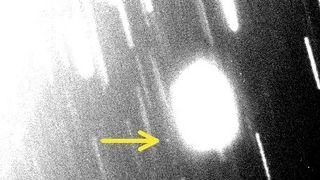
a black and white, blurry image with lots of white streaks. There is a white blob in the center-right. To the very left of thto which a yellow arrow is pointing.
The discovery image of the new Uranian moon S/2023 U1 using the Magellan telescope on November 4, 2023. Uranus is just off the field of view in the upper left, as seen by the increased scattered light. S/2023 U1 is the faint point of light in the center of the image. (Image credit: Scott Sheppard)


On the Astraveo podcast:

Tuesday, December 5, 2023

Saturn's icy moon may hold the building blocks of life

Phys.org:

Evidence indicates that Saturn's icy moon Enceladus is an 'ocean world' that contains all three, making it a prime target in the search for life. 

During its 20-year mission, NASA's Cassini spacecraft discovered that ice plumes spew from Enceladus' surface at approximately 800 miles per hour (400 m/s). These plumes provide an excellent opportunity to collect samples and study the composition of Enceladus' oceans and their potential habitability.

Now, researchers from the University of California San Diego have shown unambiguous laboratory evidence that amino acids transported in these ice plumes can survive impact speeds of up to 4.2 km/s, supporting their detection during sampling by spacecraft.  

PNAS:

The icy moons of Saturn and Jupiter, Enceladus and Europa, are particularly promising for hosting life, as they have shown evidence for the three important criteria: water, energy, and organic chemicals. Both moons eject their subsurface ocean material as a plume of icy particles, providing the opportunity to study the ocean composition and potential habitability via plume flythrough sampling. 

We show that amino acids entrained in ice grains can be detected intact after impact at speeds up to 4.2 km/s and that salt reduces their detectability, validating the predictions from other model systems. Our results provide a benchmark for this orbital sampling method to successfully detect signs of life and for the interpretation of past and future data.


I've always been personally excited by the original Enceladus discovery made by Cassini. It was already such a bizarre little moon to begin with, with the smooth southern geography, but the discovery of these liquid water plumes indicating a warm ocean under the surface was absolutely wonderful. There tends to be excitement and interest in finding aliens far outside of Earth, but if we honest-to-goodness to find alien life or at least the building blocks for it, it'll likely be in the plumes of Enceladus, quite close to home.


The sleep mask that solved my sleep problems

As previously reported on this blog, I've been actively seeking ways to unwind and, in particular, improve my quality of sleep. I've...