Showing posts with label astronomy. Show all posts

Friday, February 23, 2024

Astronomers spot new tiny moons around Neptune and Uranus

Carnegie Science:  

The Solar System has some new lunar members—the first new moon of Uranus discovered in more than 20 years, and likely the smallest, as well as two new moons of Neptune, one of which is the faintest moon ever discovered by ground-based telescopes.

“The three newly discovered moons are the faintest ever found around these two ice giant planets using ground-based telescopes,” explained Carnegie astronomer Scott S. Sheppard. “It took special image processing to reveal such faint objects.” 

Discovering all three of the new moons required taking dozens of five-minute exposures over three- or four-hour periods on a series of nights. These exposures were shifted by the apparent motion of each respective planet and added together to create one very deep image. Using this time intensive observing technique on some of the largest telescopes in the world allowed the survey images to go deeper than any previous observations near Uranus and Neptune.

Follow-up observations on the Magellan telescopes in October of 2021 and again in 2022 and November 2023 confirmed the brighter Neptunian moon as orbiting Neptune.

NBC:

Astronomers have found three previously unknown moons in our solar system — two additional moons circling Neptune and one around Uranus.

The latest tally puts Neptune at 16 known moons and Uranus at 28.

One of Neptune’s new moons has the longest known orbital journey yet. It takes around 27 years for the small outer moon to complete one lap around Neptune.

Space.com:

Uranus' new moon, the first detected around the ice giant in over two decades and possibly the smallest of its ilk, is just 5 miles (8 kilometers) wide; it takes 680 days to complete one orbit around Uranus. In comparison, one Mars' moons named Deimos, considered to be among the tiniest known moons in our solar system, is 8 miles (13 km) wide. 

The discovery was made using observatories in Hawaii and Chile by Scott Sheppard, a staff scientist at Carnegie Science, in collaboration with Marina Brozovic and Bob Jacobson of NASA's Jet Propulsion Laboratory (JPL), David Tholen of the University of Hawaii, Chad Trujillo of Northern Arizona University and Patryk Sofia Lykawa of Kindai University.


One of the discovery images shows how insanely faint the moon is compared to Uranus itself (already a very dim object from Earth):
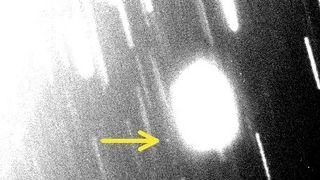
a black and white, blurry image with lots of white streaks. There is a white blob in the center-right. To the very left of thto which a yellow arrow is pointing.
The discovery image of the new Uranian moon S/2023 U1 using the Magellan telescope on November 4, 2023. Uranus is just off the field of view in the upper left, as seen by the increased scattered light. S/2023 U1 is the faint point of light in the center of the image. (Image credit: Scott Sheppard)


On the Astraveo podcast:

Monday, September 11, 2023

Mysterious Black Hole Twins May Fuel The Brightest Galaxies in Space

ApJ:

We propose that AGN flux variability and changes in jet morphology can both be of deterministic nature, i.e., having a geometric/kinetic origin linked to the time-variable Doppler beaming of the jet emission as its direction changes due to precession (and nutation).

We demonstrate this modulating power of precession for OJ 287. For the first time, we show that the spectral state of the spectral energy distribution (SED) can be directly related to the jet's precession phase.

We show that for OJ 287 precession seems to dominate the long-term variability (≳1 yr) of the AGN flux, SED spectral state, and jet morphology, while stochastic processes affect the variability on short timescales (≲0.2 yr).

OJ 287 is an incredibly interesting object. It's a massive quasar that we've observed periodic outbursts in for >100 years, which are attributed to a ~100 million solar mass black hole orbiting a much larger 18 billion solar mass black hole. (For context, the huge M87 black hole was "only" 6 billion solar masses). This paper specifically attributes the emission to the precessing jet caused by the orbiting black holes.

ScienceAlert:

Led by astronomer Silke Britzen of the Max Planck Institute for Radio Astronomy in Germany, an international team studied 12 blazar galaxies, finding an interpretation of circling black holes could be applied to all of them.

This could be a clue as to how supermassive black holes millions to billions of times the mass of the Sun grow to such tremendous size.

We currently lack instrumentation with the resolution to observe the disk architecture that would reveal these binary black holes, but continued monitoring of the precession, as well as long-term observation of other blazars, could continue to yield information about their existence.

Space.com:

Jets blasted out by feeding supermassive black holes at the hearts of active galaxies could brighten and curve due to a "wobble" caused by a second orbiting supermassive black hole, a new study reports.

"We present evidence and discuss the possibility that it is, in fact, the precession of the jet source, either caused by a supermassive binary black hole at the footpoint of the jet or — less likely — by a warped accretion disk around a single black hole, that is responsible for the observed variability," study leader Silke Britzen, a researcher at the Max Planck Institute for Radio Astronomy in Bonn, Germany, said in a statement.

The team can't fully rule out factors in jet physics, such as shock waves or instabilities in the jet, or even magnetic fields, as the driving force behind the curved jets. However, they argue, the jets in question wouldn't be quite as curvy or as bright if it weren't for their wobble.


Previously on this blog:


Sunday, June 4, 2023

SN 2023ixf early photometry

This supernova just exploded in the galaxy M101, just 6 Mpc away, making it the closest supernova since SN 2011fe. Research groups around the world are scrambling to conduct analyses of this object. Some have already started popping up on arXiv.

arXiv:

We present the early-stage analysis of the low-resolution (R=1000) optical spectra and the near-infrared light curves of the bright Type II supernova (SN II) 2023ixf in the notable nearby face-on spiral galaxy M101, which are obtained since t=1.7 until 8.0 d.

Compared with SNe II showing the flash-ionized features, we suggest that this SN could be categorized into high-luminosity SNe II with a nitrogen/helium-rich circumstellar material (CSM), e.g., SNe 2014G, 2017ahn, and 2020pni. 

These observational facts support that SN 2023ixf is well consistent with a high-luminosity SN II with the dense nitrogen/helium-rich CSM.

It's great to see the comparisons to previous objects. 23ixf doesn't have too many remarkable qualities aside from some very early flash features (and its proximity), but it's difficult to find good comparisons since we really don't get to observe SNe early this often.

Wednesday, May 17, 2023

A radio-detected Type Ia supernova with helium-rich circumstellar material

arXiv:

However, despite extensive efforts, no SN Ia has ever been detected at radio wavelengths, which suggests a clean environment and a companion star that is itself a degenerate WD star. Here we report on the study of SN 2020eyj, a SN Ia showing helium-rich CSM, as revealed by its spectral features, infrared emission and, for the first time in a SN Ia, a radio counterpart. Based on our modeling, we conclude the CSM likely originates from a single-degenerate (SD) binary system where a WD accretes material from a helium donor star, an often hypothesized formation channel for SNe Ia. 

nature

The CSM interaction in SN 2020eyj is also confirmed, for the first time in a SN Ia, through the detection of a radio counterpart, at a frequency of 5.1 GHz at 605 and 741 days after the first detection. Follow-up in the X-rays did not yield a detection. We model the radio synchrotron emission, which results from the shock interaction between the ejecta and the CSM.

For the SD shell model, the radio detections are best explained with a CSM mass of M_csm = 0.36 M⊙ (see ‘CSM shells’ section in Methods), with the expectation that the radio light curve will start to drop off rapidly at around 900 days. 


 Previously on this blog:

Tuesday, March 14, 2023

The core degenerate scenario for the type Ia supernova SN 2020eyj

arXiv:

We argue that the core degenerate (CD) scenario of type Ia supernovae (SNe Ia) can explain the compact helium-rich circumstellar material (CSM) of SN 2020eyj...We follow the evolution of two stellar models with initial masses of 5Mo and 7Mo to their asymptotic giant branch phase when they are supposed to engulf the WD companion. We find that there is a sufficiently massive CO core to merge with the WD in the frame of the CD scenario as well as a massive helium-rich layer, ~0.3-1Mo, to account for the helium-rich CSM of SN 2020eyj.

The motivation of our study is the new observations of SN 2020eyj, a SN Ia-CSM with a helium-rich CSM (Kool et al. 2022) and the need to consider all SN Ia scenarios when analysing observations, as the long list of recent papers that study different scenarios suggests.

Building on earlier papers that argue for the CD scenario for SNe Ia-CSM (section 2) we propose the CD scenario also for SN 2020eyj, but we consider a new channel that accounts for the helium-rich CSM (section 3).


Saturday, March 4, 2023

Potential comet for 2024: C/2023 A3

MPEC:

Q.-Z. Ye reports cometary activity of an asteroidal NEOCP candidate (initially reported by ATLAS South Africa - M22 on Feb. 22 UT) in prediscovery images obtained by Palomar Mountain-ZTF (I41) on Dec 12, 2022 UT, noting a very condensed 2" coma and a straight 10" tail at position angle 230-250 deg. The object was independently discovered on Jan. 9 UT at Purple Mountain Observatory, XuYi Station (D29).

EarthSky:

At discovery, the comet was still 7.3 astronomical units (AU) from the sun, and shining at a dim magnitude 18.

Preliminary analysis of its trajectory suggests comet “A3” completes an orbit around the sun every 80,660 years. As of March 2023, the celestial visitor is currently between the orbits of Saturn and Jupiter. Although some specific facts and dates might be updated, currently it appears that closest approach to Earth should occur on October 13, 2024 at 05:38 UTC.

LiveScience:

As viewed from Earth, the comet may be as luminous as the brightest stars in the sky during its upcoming flyby, according to EarthSky. This is brighter than the green comet C/2022 E3 that just passed by Earth in January. That comet had a brightness of around magnitude +4.6, just visible to the naked eye. The new comet may have a brightness of magnitude 0.7, potentially peaking at magnitude -5, similar to Venus at its brightest(opens in new tab). (Lower numbers mean greater brightness on the stellar magnitude scale.) 

Much is yet unknown about C/2023 A3, including its size. Without more data, astronomers are still debating the comet's chances of survival. In a message chain for astronomers(opens in new tab), University of Pennsylvania postdoctoral researcher Qicheng Zhang(opens in new tab) summed up the situation, calling C/2023 A3 the most promising comet in years to provide naked-eye views but cautioning that these hopes could be dashed. "C/2023 A3's survival, while promising, is not guaranteed at this point," Zhang wrote.

I plan on following this comet closely! Excited to see what mass measurements come out, and it will be fun to try and photograph it.

The sleep mask that solved my sleep problems

As previously reported on this blog, I've been actively seeking ways to unwind and, in particular, improve my quality of sleep. I've...