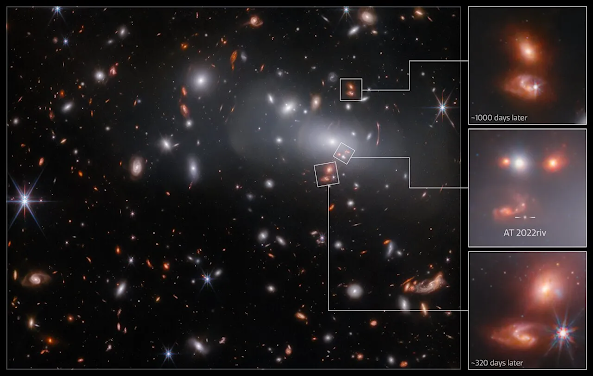
This observation from the NASA/ESA/CSA James Webb Space Telescope contains three different images of the same supernova-hosting galaxy, all of which were created by a colossal gravitational lens. In this case, the lens is the galaxy cluster RX J2129, located around 3.2 billion light-years from Earth in the constellation Aquarius.
Astronomers discovered the supernova in the triply-lensed background galaxy using observations from the NASA/ESA Hubble Space Telescope, and they suspected that they had found a very distant Type Ia supernova.
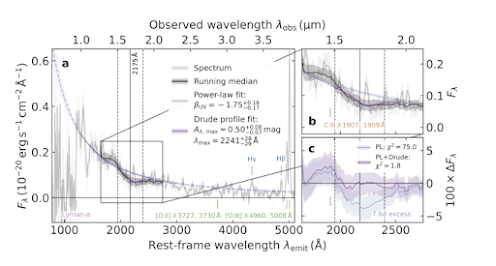
SNe Type Ia function as standard candles, so if it really is Type Ia it could be used to determine a cosmic distance to RX J2129. However, I'm curious as to how they made this determination, as I didn't see any conclusive lightcurve or spectra associated with this find. No one has classified the supernova on TNS either. Update: apparently spectroscopy was obtained by NIRSpec but it's not clear if classification was possible.
The image features a huge galaxy cluster called RX J2129, located 3.2 billion light-years away, which is acting as a magnifying glass and bending light coming from more distant galaxies behind it. That’s what is causing the stretched-out shape of some of the galaxies toward the top right of the image.
CNET:
Not only does the galaxy appear three times, but it appears at different points in time. A supernova -- a bright exploding star -- is visible in the earliest version of the galaxy. The second and third images, from about 320 days and 1,000 days later, show that the supernova has faded away. An annotated version of the image points out these cool features:
Astronomers are now adept at spotting the telltale effects of gravitational lensing, but that wasn't always the case. Four decades ago, the concentric arcs of light and stretched celestial objects could be downright confusing. In 1987, an enormous blue arc thought to be hundreds of trillions of miles long was first considered one of the largest objects ever detected in space. The arc was found near the galaxy cluster Abell 370, with another similar object near galaxy cluster 2242-02.